


'It's Like My Brother Died'
Two years after China ended international adoption, families wait in grief and hope
Jennifer Kelley named her would-be adoptive son “Bo,” after the biblical figure “Boaz.”
Kelley, a mother of four, chose a simple name for a Chinese boy who was promised a new life in the United States. In Hebrew, the name means strength.
Bo, now 17, should have been home in spring 2020, with the Kelleys, a family from Greenfield, Indiana. The family includes two girls, Grace and Ruthie, who were both adopted from China.
As she waited for Bo, Kelley kept herself busy.
She prepared some socks for him. She added his name to the kitchen wall displaying the birthdays of each family member and posted his photos on the fridge. She kept a quilt that her friend made for Bo, who like Grace, has cerebral palsy.
Bo never came. He was among the scores of children left in limbo in China due to Beijing's ban on a foreign adoption two years ago.

“I know it's in God's hands. It is how I look at it. And there is nothing I can do,” said Kelley in an interview.
The Kelleys were among 300 U.S. families who were left in limbo after China banned foreign adoptions in August 2024. Most of the children, like Bo, were the ones few families wanted. They have disabilities ranging from birth defects to chronic conditions that need round-the-clock care. They languished in the orphanages.
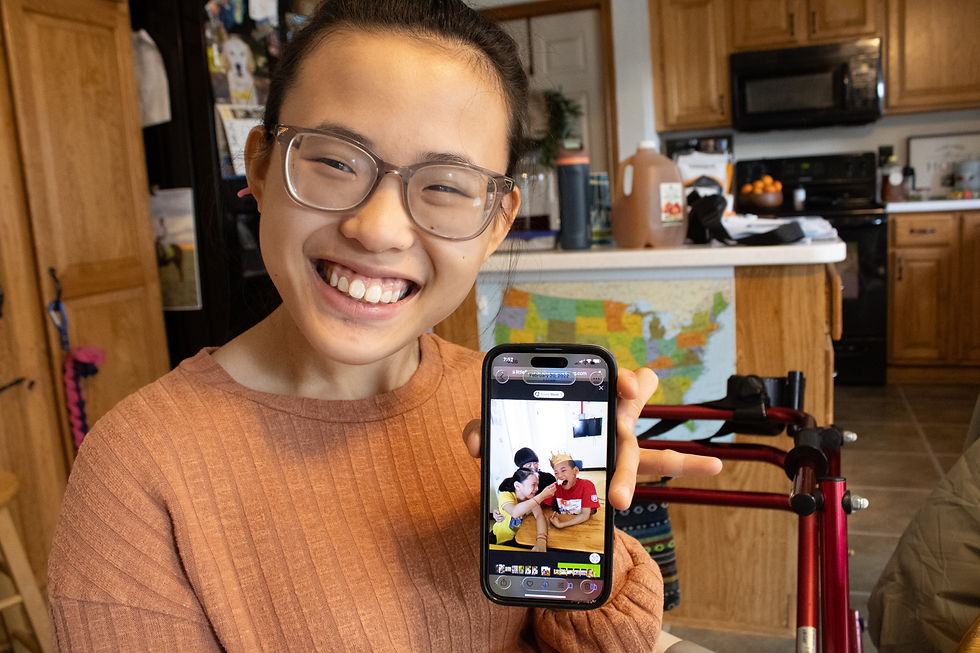
On a brisk Saturday in fall, Kelley recounted her story amid the chatter of teenagers and the barking of her six dogs in her house. Grace had a photo of herself with Bo when they were in the orphanage. She wore a yellow T-shirt and heaped a spoonful of cake near Bo’s mouth. Bo, in a red top and crown, opened his mouth widely.
By 2020 when the global pandemic struck, China suspended all international adoptions to prevent travel.
Families like the Kelleys that were matched with children before Covid waited until 2023 when China reinstated foreign adoptions. Only 16 cases were finalized this year. A year later, China announced that all adoptions would be permanently banned and had made exceptions only for foreigners adopting stepchildren and children of blood relatives.
Some families have turned to adopting from other countries. And some are pushing to get the ban lifted, at least for families already matched with children in China.
Hope Leads Home, a grassroot coalition founded by families after the ban took effect, has been calling for the U.S. president to intervene. In December 2024, families persuaded 33 governors to sign a letter pressing then-Pres. Joseph Biden to get China to finalize these pending adoptions and “fulfill the commitments made to these children and families.” They later persuaded 105 Congress members to write to Pres. Donald Trump to get him to act on the matter.
But not much has happened.
The State Department said it has been asking the Chinese government to clarify its stance in a statement.
“It honestly never occurred to me that China would break its word,” said Aimee Welch, a Kentucky mother who launched Hope Leads Home.
Welch adopted her daughter, Grace, from China in 2017 and has been waiting since 2019 for another adoptee, 11-year-old Penelope.
”I'm still hopeful that maybe we will find the right person with a compassionate heart and goodwill, [who] would be able to fix the process, at least to bring home the children who were already matched with families,” Welch said.
***
More than 160,000 Chinese children have been adopted into families all over the world since China officially opened its doors to international adoption in 1992, according to China’s Children International, a nonprofit that tracks the data.
Half of them came to the United States, the State Department data shows.
Scaling back has been a global trend, said Adam Pertman, author of “Adoption Nation: How the Adoption Revolution Is Transforming Our Families—and America.” In an interview, he said the idea that international adoption was a perfect system that connected orphans and families had been questioned as concerns about child trafficking and corruption surfaced.
Karla Thrasher, senior director of international adoptions at Lifeline Children’s Services, an Alabama adoption agency, said she was not surprised by the ban on foreign adoptions.
“What did take us more by surprise is that they weren't going to allow the families already matched with children to continue their adoption,” said Thrasher.
China’s one-child policy, enforced from 1979 to 2015, led thousands of families to abandon children, primarily girls deemed less desirable in traditional Chinese culture.
Children with disabilities are the vulnerable charges now being dropped off unwanted at China’s orphanages, said Thrasher. According to China’s data, 95% of children adopted by foreign families between 2014 and 2018 were disabled.
***
Kelly Black and her family, who live in Esko, Minnesota, started their application to adopt a Chinese boy they called Judah in 2018. Judah has Down syndrome and grew up in an orphanage. All was going well until the 2024 adoption ban.
Black’s oldest son had been anticipating the little brother from China since kindergarten. In the bedroom that he was going to share with Judah, he decorated the wall with posters of Mandarin characters. He kept telling his friends that he would be travelling to China with his family.
“It’s like my brother died,’’ he told his mom when the ban was announced.
Black baked a cake with her three children to mark Judah’s birthday each May. They always made a peach cake, because that was the flavor that Judah had at his birthday party in the orphanage. Black said she wanted to start a tradition from afar with Judah, hoping that he would “have a sense of connecting to things that felt similar” when he joins the family.
The May after China announced the ban, the Blacks baked another peach cake in his honor. They cried as they planned the event.
“I said, it's OK to be sad and to process this,” Black recalled, “but we can miss him and be sad and make the peach cake too, to continue to remember and honor him.”
***
“China's not in the picture anymore.”
Russell Wong and his wife, who live in San Ramon, California, always knew they were looking to adopt an Asian child, hoping that the child would find it easier to adapt to a family of the same race. When they realized finding an Asian child through domestic adoption was very rare, they decided to look internationally.
In 2018, Wong saw the profile of a six-year-old boy from an orphanage in Guangzhou, China. Born with six fingers on each hand, he was abandoned only a few days old. The Wongs hoped they could welcome the boy that they called Samuel home in a year.
When the pandemic ended and adoptions had resumed in all countries but China, Wong started losing hope that he would be able to meet Samuel. The wait had been disheartening.
“When it was announced, there was some relief that at least we have an answer,” he said.
They were told by their adoption agency, Nightlight Christian Adoptions, that they could transfer to another country without additional costs, but they refused.
Wong called the ban a “brash decision,” taking away orphans’ hope for a family that really wants them.
Kelley recalled when she first heard about Bo, briefly in 2018 on a trip in Inner Mongolia, China. She traveled there to pick up Grace from an orphanage where she learned that Bo was Grace’s best friend. After returning home, she and her husband quickly got their adoption paperwork in order, submitted it in 2019, and waited for approval to travel to China to bring Bo home.
She worried that she would lose track of Bo, that he would be moved to an adult care facility once he reaches 18 next February.
“I don't know what the future holds for him,” she said. “Where he's going to go, and who's going to take care of him?”


Comments