


'People Just Don't Know Filipinos'
Trish Fontanilla of BOSFilipinos talks identity, diversity
When Trish Fontanilla was a child, she had two birthday parties. One had pizza and a yellow sheet cake and was celebrated with her classmates. The other had lechon and karaoke and was celebrated with her Filipino community. Although her parents didn't intend this, Fontanilla said she grew up thinking her life had to be lived in two identities: Filipino or not.
“I’d always felt like, ‘When you're around Filipinos you act a certain way, when you’re around non-Filipinos you act a certain way,’” Fontanilla said.
After growing up in a predominantly white town in New Jersey, Fontanilla went to Emerson College, where she finally realized, “Oh, I’m a whole human with these experiences.”
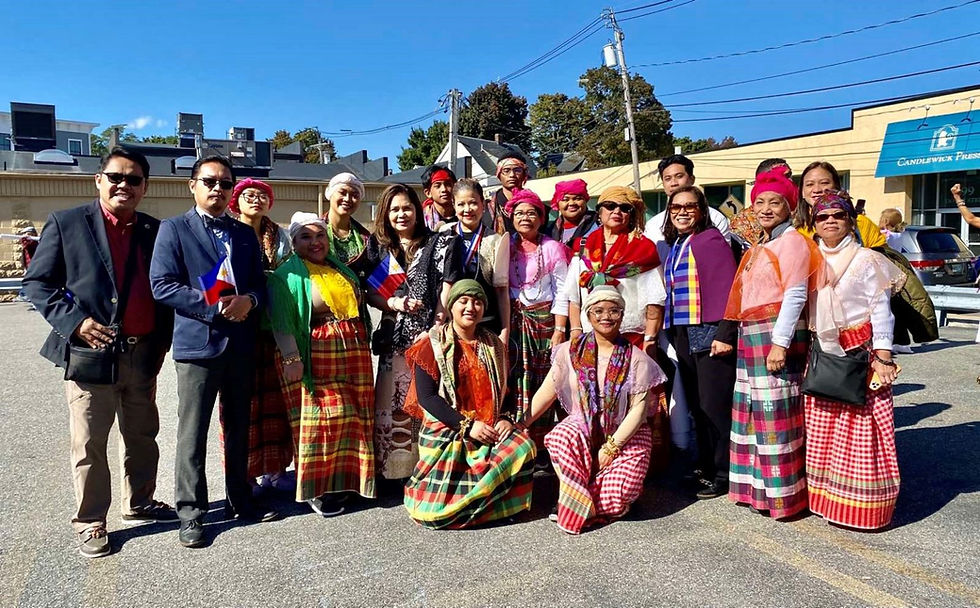
That realization helped lead her to cofound BOSFilipinos, a self-funded community organization that aims to connect Filipinos in the Greater Boston area through educational and cultural events, monthly podcasts, and collaboration with other organizations.
“I saw this need for Filipinos, especially folks that didn’t speak Tagalog, folks that are biracial, folks that didn’t present as Filipino,” Fontanilla said. She doesn’t speak Tagalog, one of the major dialects in the Philippines.
Fontanilla, who describes herself as “Chief Energy Officer,” founded BOSFilipinos with Leila Amerling and Bianca Garcia in 2017. Before the pandemic, the group would have bi-monthly meetings, weekly blog posts, and Filipino food pop-ups. The last big event they hosted in December 2019 was a Noche Buena potluck, a Filipino Christmas Eve tradition, at St. Anthony’s in Downtown Crossing. Fontanilla said the church even brought a Filipino priest in for the event.
“I want to create this space because if we don't talk about ourselves and we don't build our own community, no one else will do that,” Fontanilla said. “In fact, there are some people that are trying to actively erase us.”
According to the Migration Policy Institute, as of 2023, Filipinos made up the “fourth largest national-origin immigrant group” in the United States. The immigrant group follows Mexicans, who are the third largest group, Indians, and Chinese. Just about one in seven “Asian-born immigrants” in the U.S. were from the Philippines, according to the Migration Policy Institute.
Post-pandemic, Fontanilla said she has been playing around with the format of BOSFilipinos and looking into different funding opportunities, since it is not a nonprofit. The most recent event was on Nov. 14: Coworking with BOSFilipinos, which was communicated about through Instagram. Media plays a significant role in the way BOSFilipinos spreads education. The website archives of blog posts contain recipes for adobo, interviews with fellow Filipinos, book recommendations, pieces about identity or culture or what celebrities have a little bit of Filipino heritage, and more. Today, Fontanilla publishes a monthly podcast on the BOSFilipinos website where she interviews people from the community.
“I've highlighted hundreds of Filipinos across different professions, because I also feel like we do get pigeonholed to doctor, nurse, entertainer,” Fontanilla said. “I want Filipinos to be seen.”
The seed for BOSFilipinos was planted when Fontanilla met three Filipino women at a networking event. Before this, Fontanilla had moved to Boston for college without knowing anyone nearby. The friends started holding potlucks, inviting more people, and posting on social media — to which more people showed interest in being a part of. Fontanilla said she was missing the Filipino community and in search of people to build it with.
“I feel like a lot of people leave Boston, because they don't feel a sense of community,” said Fontanilla. “And I do think identity comes into play a lot.”
Hyacinth Empinado, a former BOSFilipinos video producer, said she also had trouble finding a Filipino community when she first came to Boston.
“I went to a few Filipino-centered church gatherings, but they were not in the city, and a lot of the people there were mostly older, so having a community like BOSFilipinos is really wonderful,” Empinado said.
Empinado, who is from the Philippines, created a video series for BOSFilipinos in which she would teach Tagalog words to Fontanilla — filming sessions during which they had a lot of laughs, according to Empinado. She credited BOSFilipinos with bringing together Filipino young professionals like herself. “Now that I'm raising half-Filipino kids, I hope that they would find a community like this one day and find camaraderie with fellow Filipinos."
One of the first BOSFilipinos events was a Filipino food pop-up in 2017, right before a Filipino restaurant called Tanám (now closed) opened in Somerville. Before that, Fontanilla said the only Filipino food spots were in Quincy or Worcester, which were not reasonably accessible for college students. BOSFilipinos made sure that the pop-ups were in Boston and Cambridge and T-accessible.

“I love Filipino resilience and creativity, and the concept of bayanihan, which is the community coming together to help each other,” Empinado said. “We as a people have been through a lot, and Filipinos know how to find creative solutions when resources are scarce.”
Fontanilla’s parents are also from the Philippines — her mother’s side is from Pangasinan and her father’s is from Iloilo. Because she grew up in a predominantly white area with parents who only spoke Tagalog when they didn’t want their kids to understand, Fontanilla has a unique perspective on being Filipino in the U.S. She recounted an experience she had in elementary school. “I was in class, doing one of those standardized tests, and I was filling in the 'Asian' bubble,” Fontanilla said. “And my teacher was like, ‘Oh, you're Pacific Islander now.’ And I was like, ‘OK.’ And then I remember taking another test, and Pacific Islander wasn't an option, so she was like, ‘On this test, you're Asian.’”
Experiences like this contributed to the lack of wholeness that Fontanilla said she felt, along with feeling that the Filipino part of her identity was separate and without a designated bubble or box to fit into. This is why she aims to create a space where everyone feels welcome. Being Asian or Filipino is not a monolith, she said, and especially in the U.S., not every person looks alike.
Fontanilla said a woman at a Filipino festival in Malden approached her and said, “‘I know I don't look Filipino.’ I said to her, ‘What does that even look like?’ Both of my parents are from the Philippines and people tell me I'm too light-skinned to be Filipino.”
According to the Pew Research Center, 21% of people who identify themselves as Filipinos are most likely to also identify as multiracial. Fontanilla said she’s had people attend events who don’t speak any Filipino dialects, are biracial, or bring their non-Filipino partners.
“All of the othered experiences I've had in my life — I actually funnel into my work because I know what it's like to not feel like you're a part of the group,” said Fontanilla, who also works part-time at Wentworth Institute of Technology in programming for the school’s entrepreneurship co-op and freelances.
Fontanilla’s mother was part of the first wave of Filipino nurses who came to the U.S. Filipinos make up 4% of the nursing workforce in the nation, according to the National Institutes of Health Record.
“We're the nurses, we're the caregivers,” Fontanilla said. “We're the cruise directors or the entertainers. We're visible in all these places, but we still don't get recognized or people are like, ‘Oh, that person's Mexican or they're Chinese. People just don't know Filipinos.”
BOSFilipinos is still pushing to get more Filipinos to speak at Asian events and tell their stories through the media. Fontanilla said most of these events spotlight East Asian people and Filipinos usually aren’t featured, when they should be recognized more often for what they bring to the table. “Filipinos have done some really incredible things... We can't be the only people talking about us, because if we are, we can't build that empathy, we can't build that knowledge and our storytelling needs to be passed down, not just by us, but, by other people that know us, too.”


In the Dark Ages when those census reports were new in school I remember the teacher in my new junior high sort of rolling her eyes and sighing "we have to take this survey now, just raise your hands. Everyone who's white, she counted. Everyone who's Black, she counted. Other?" So the TWO of us in the class that were hapa raised our hands. "Othering" yeah, been there, lived that! I'm so glad younger friends and people in the community have real community now.