


Power in Print
Updated: May 20
Guerrilla Mag puts up a fight for Black, queer and ‘femme’ communities in Boston
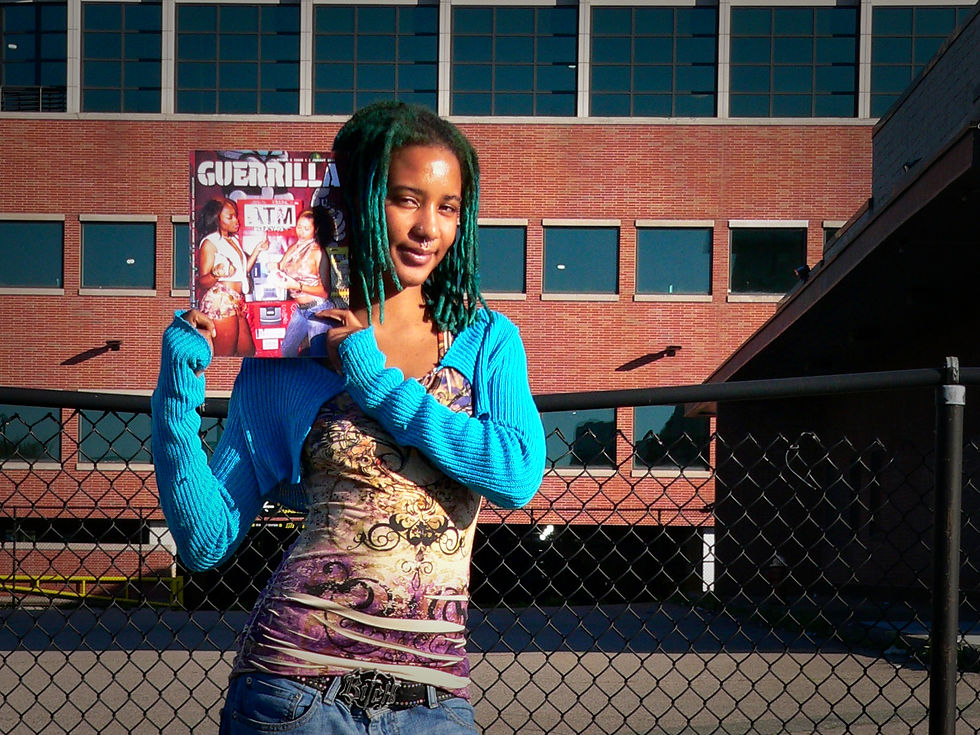
Drum beats from a practicing musician thump up and down the hallway, as Vikiana Petit-Homme sits on a couch in an arts studio in Dorchester. The 24-year-old editor and activist is holding a copy of her newest issue of Guerrilla Mag, a zine she edits with a friend and model, Tatiana White. This particular copy of the glossy magazine is smeared with fingerprints. It has clearly been heavily handled since it was printed earlier this year. But the worn out cover of her copy of Guerrilla’s No. 2 issue can’t hide the vibrant and striking design of the work that Petit-Homme can’t stop talking about.
“It’s grungy,” says the editor earlier this week, “We want it to have that punk feeling.”
In that, Guerrilla Mag succeeds. The zine – or do-it-yourself magazine – she says, aims to do good for her community – and it is proudly biased. She called the zine project "very pro-Black, anti-capitalist, pro-queer and anti-Zionism."
Guerrilla's cofounder White, 25, adds that the magazine is an "archival project" that documents the urban underground in Boston's Black community. "We want to make a political statement but to make it fun and creative."
The first issue of Guerrilla began in 2024, as campus protests against the genocidal attacks on Gaza popped up in Boston and beyond and then got crushed by authorities. Some of that issue highlights the encampments – and serves as a stinging, physical reminder of that period of institutional hysteria around all things Palestine. Other parts of the magazine review music albums, advise on whether to keep or quit your job, guide you on how to learn the guitar, feature poetry, and explain about the Boston nonprofit group Heal the Hood. Photos of style, DIY glam and music and local models punctuate the pages.

On the cover of this recently released second issue is a photo of two women standing in front of an ATM at night. The theme, says Petit-Homme, is “where is our space?” And, she says, a big part of that question has to do with how expensive this city is. This is a topic that Petit-Homme comes back to a lot during our conversation: The high cost of living. At one point, she says, who knows if the studio space where she was sitting during the chat with this reporter would even exist next year? At another point, she notes how so many of her colleagues in Boston have had to move out because the city’s too expensive.
“A lot of us are just fighting to be in Boston, to stay here,” she says. And Guerrilla is all about this kinda of fight – and community struggle – she notes, hence the name, Guerrilla.
A Voice of Change
Powered in part by funding from the New England Foundation for the Arts, the Guerrilla project’s mission is to celebrate and amplify the Black voices and artists of Boston – especially those identifying as queer. It’s also to rebel against corporate media. One could argue that the reach of this project is still small. The print circulation of the first issue was only about 100 copies and the second even fewer. But the group has also been vocal on social media (where it has a large following), promotes itself with actual parties, and pushes its website, which sells PDF copies, and posts some of Guerrilla’s stories. Ironically, just down Morrissey Boulevard from where Petit-Homme spoke with this reporter, is the ghost of the old Boston Globe headquarters, a still powerful symbol of when newspapers and other legacy media were information gatekeepers.
Long before she conceptualized Guerrilla with her co-editor Tatiana White, Petit-Homme had been working in advocacy, activism and organizing. Originally from Haiti, she says she’s been speaking out against gun violence – and the poverty that often causes it – since she was a teen and quickly notes her native nation’s own history of revolution as one of her inspirations. Her day job is at the Dudley Street Neighborhood Initiative, and that organizing work, she says, has prepared her for building up Guerrilla. When designing the zine, she tapped into the poster- and flyer-making skills she learned while setting up notices for protests, to advocate for legislation, and to bring attention to social justice issues. White, she says, meanwhile, brings in a sense of style to the zine.
“The role of the artist is to make the revolution irresistible,” says Petit-Homme, quoting the late writer and activist Toni Cade Bambara.
This seems to be a guide for how Petit-Homme, who majored in Africana Studies at UMass-Boston, puts together Guerrilla, mixing eye-popping imagery and serious prose with light how-to columns. She says most of the effort is led by “femme” voices.
“We’ve always known how important storytelling has been,” she says.
PEN TO PAPER: Pages from the first issue of Guerrilla Mag. Courtesy of Guerrilla Mag.
Paper for Record
Petit-Homme and White both grew up in the social media era when legacy newspapers began going bankrupt, getting sold off, shrinking and in some cases closing shop altogether. Many print magazines also faded away since she was born. Meanwhile, Facebook, Instagram, TikTok, X and YouTube began to draw in and hook massive audiences. But she says putting out print copies of Guerrilla as well as offering it for download, allows for physical works that can be kept for generations, archiving these times and the lives in her community. More to the point, she acknowledges that the types of stories and columns her zine prints have little demand from the mainstream.
“The stories we’re telling are not algorithm-friendly,” she says.
This rings true for Janaya Hewitt who also goes by the penname Jai Monet, who wrote stories in both issues of Guerrilla. The first was about the Jamaica Plain-based community group, Heal the Hood, which helps feed low-income residents, and another about the “adultification” and sexualization of kids.
“It feels like an incredible way to bring community back together,” she said of Guerrilla. “We are telling our stories.”
Hewitt/Monet, 28, said that after spending years isolated during the pandemic, she and many of her peers had to learn how to socialize again. “It made people uncomfortable with interaction.”
Print zines offer what online media can’t, says Petit-Homme and Monet: They are something that can be held and kept – and are “tangible.” For Petit-Homme and White, having actual zine release parties with actual prizes – like CD players and where mixed CDs are made – are all part of building a community.
“We want to bring back physical media,” says Petit-Homme.

Mixing Party and Print
And it appears the presence of Guerrilla is set to grow this summer. Petit-Homme and Guerrilla scored a $30,000 grant for their “The Let Out” project from New England Foundation for the Arts. Billed as a “late-night public talk show and spatial justice intervention,” the project is slated to host outdoor nightlife events in Dorchester, Roxbury, and Mattapan for Black and other minority and queer adults ages 18–35. The Let Out is inspired by a project led by Brazil's Claudio Prado who helped document the club-scene nightlife with an outdoor living room-style studio in Sao Paulo. The plan is to have six professionally video recorded talk show-style episodes that will complement the stories told in Guerrilla, say Petit-Homme and White. The talk show will be broadcast online and focus on young adults after the clubbing and parties "let out."
"The Let Out challenges misinformation, cultural erasure, and the privatization of public space by building a people-powered broadcast directly in the nightlife environments where our communities gather, create, and organize,” reads a description from the arts foundation.
Petit-Homme says the initiative will be "part of our mission of creating a space for community youth for storytelling."
Building on a Legacy
Prior to Guerrilla, Petit-Homme has, in fact, reached out to traditional media through her advocacy work, showing she can be savvy in using new and old methods for communicating. When she was 16 and a student at the Boston Latin Academy, she penned a letter to the Boston Herald to bring awareness to gun violence, writing, “As long as people are being killed with guns, we are not doing enough. Massachusetts is not doing enough. As long as there are people dying from guns, there is more to be done.”
Around the same time she was noted for her activism in the Boston Globe. And when she was a speaker at the 2018 annual meeting of the U.S. Conference of Mayors, floating the idea of lowering the voting age to get youth more engaged in politics and their voices heard, her talk was broadcast on C-Span. More recently her work with the Dudley Street Neighborhood Initiative was featured in a story by Yawu Miller in the Dorchester Reporter.
The editor and activist also is well aware that she is trying to give a megaphone to the voices often not heard in a city with global influence – a city literally a few T stops away from Harvard University and the Massachusetts Institute of Technology, and a city that's home to the most prized hospitals in the nation, as well as major biotechnology and military technology brain centers.
Petit-Homme seems to know that Guerrilla Mag – whose third issue is slated for print this summer – may be small in reach, but just needs to reach the right people to make good.
“A lot of important decisions,” she says, “are made in this very city.”


Comments