


Secrets of the Gate
The Chinatown landmark has endured international divisions, harsh winters and construction mishaps. Now It's About to Turn 45.
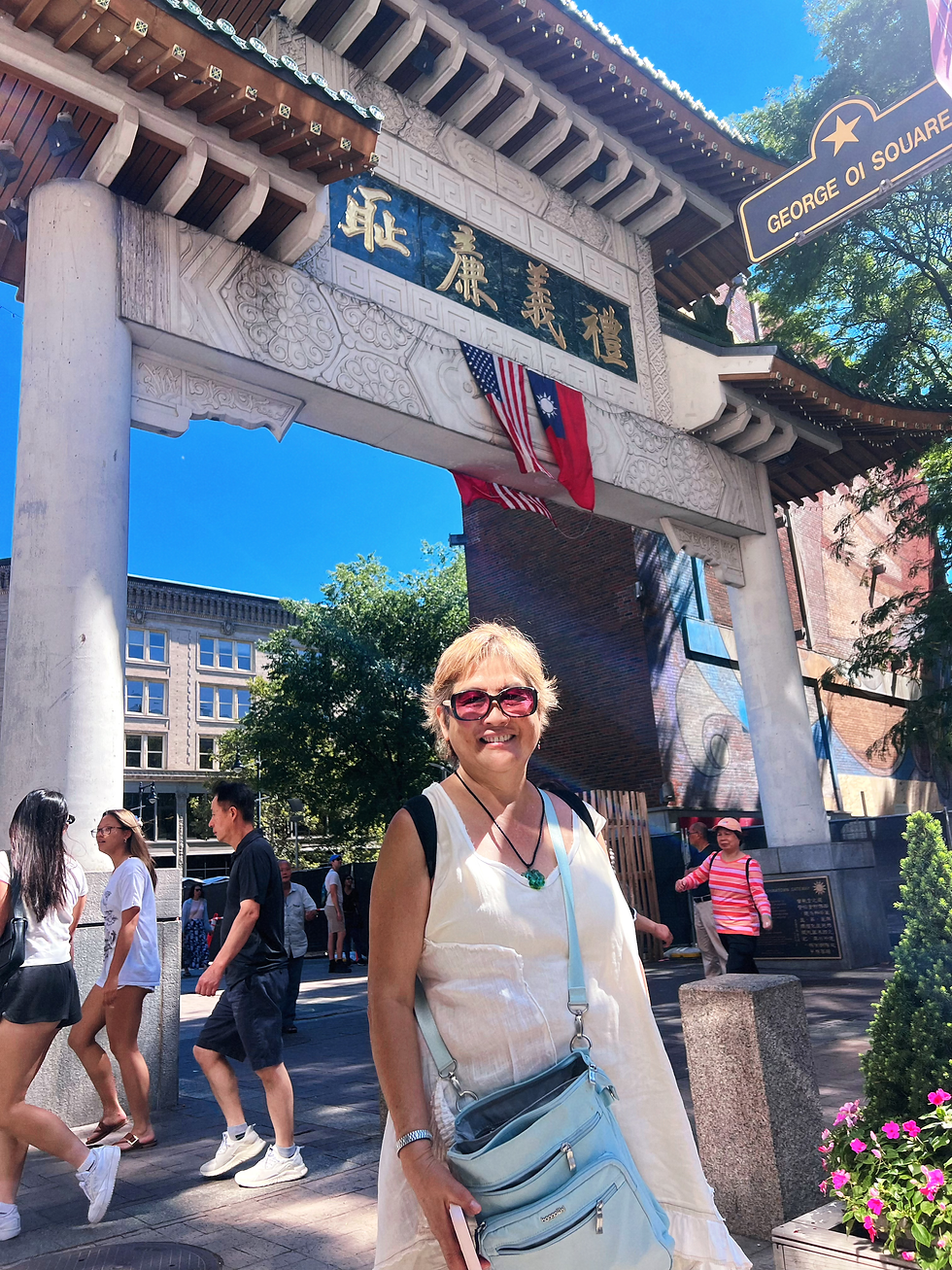
Approaching from South Station in downtown Boston, the sight of the Chinatown Gate and decorative colorful lanterns in the distance signals the arrival at Chinatown. Today, the gate is festooned with lights; in the small plaza in front of it, people gather in groups to chat. Children run and play, and tables and chairs offer a spot for passersby to rest and converse. In the small park enclosed by the fence to the left, elderly residents often gather to play cards, their laughter filling the air. Looking up, the four characters “Tian Xia Wei Gong” (“The World Belongs to the Public”) are prominently displayed on the side facing the Greenway, while the characters “Li, Yi, Lian, Chi” (“Propriety, Righteousness, Integrity, and Honor”) are inscribed on the other—guiding the bustling flow of traffic and pedestrians into this culturally unique corner of Chinatown. The history surrounding the gate—and the untold stories within—are much like the colorful lanterns overhead: mysterious, distinctive, and woven into the fabric of people’s memories.
Over the past four decades, the gate has witnessed generations of Chinatown residents grow up and has accompanied the community on its journey from humble, arduous beginnings to its current, vibrant state. Next yearr mark's the 45th anniversary of the gate's completion.
Here is the story of the Chinatown Gate.
A Belated Gift
This gift from across the Taiwan Strait did not come easily. The materials for the traditional ceremonial archway were donated by the Taiwanese government to Boston’s Chinese community in 1976. But its construction was stalled for years due to a combination of factors, including site selection, budget constraints, and cross-strait political disagreements. In particular, following the United States’ formal recognition of Beijing in 1979, there were concerns that erecting an archway donated by Taiwan might trigger political problems. It was not until the Mid-Autumn Festival celebrations in 1982 that the structure was finally unveiled, adding a striking landmark to Chinatown.
Alice Kane, the current director of the Chinese Historical Society of New England (CHSNE), also recalls the political sensitivities surrounding this history: “The gate was a gift, and it was a gift that the City of Boston was hesitant to initially receive, officially receive ... because they were concerned about the political climate at the time between People’s Republic of China and the Republic of China. So, they weren’t sure if they should accept it. So the city didn’t officially accept it. They just sort of let it sit for a while, a long while, until finally they felt reassured that there wouldn’t be any political repercussions for accepting a gift.”
The process of constructing the gate was far more convoluted than one might imagine. “Much of the materials were received in pieces. It had not been constructed yet,” recalled Kane, recounting what she had heard. “On accepting the gift officially, they finally opened everything up to assess and prepare for construction, and that’s when they discovered that a number of pieces had broken during transit.”
Lena Jung, widow of the gate’s architect Yu-Sing Jung, recalled the same predicament from a different perspective.
“The bricks were shipped from Taiwan—a time when cross-strait political tensions were high. In any case, problems arose right from the start. They couldn’t withstand the cold. Winters here are much harsher than in Taiwan; after the first winter, the bricks cracked, and we had to order replacements,” she said.
These two accounts are not necessarily contradictory; it is possible that the damage incurred during shipping and the issues caused by the unsuitable climate occurred sequentially. Fortunately, the gift was ultimately erected successfully, taking on the familiar form we see today.

The Life of a Builder
One cannot speak of the Chinatown Gate without mentioning the man who put it all together. Lena Jung recounted her husband’s early life. Born in Hong Kong, he lived through the turmoil of the Japanese occupation; at 13, he was separated from his parents and was forced to make his own way in the world. He taught himself accounting and even lied about his age to secure employment.
“He told people he was eighteen, though he was actually only around fourteen,” Lena Jung recalled with a smile. “But he was highly capable and eventually rose to a senior position because he was an outstanding accountant.”

After the war, the family reunited, and Jung subsequently moved to Canada to study architecture, eventually teaching at the University of Toronto. He later headed south to the United States, where he co-founded the architectural firm Jung/Brannen Associates and participated in numerous projects in Boston — the gate being one of them. He was also an accomplished calligrapher who had won numerous awards in Hong Kong during his youth.
“His parents did send him to Chinese school and he studied the really authentic, traditional Chinese culture,” Lena Jung said. “He was not only an architect but also a truly accomplished calligrapher.”
When asked what her husband valued most in his work, the 94-year-old Lena Jung paused to reflect before saying, “I think maybe integrity was probably the fundamental philosophy held as Chinese.”
She settled in Boston with her husband in 1967; although she was a Northerner and did not speak Cantonese, she felt that Chinatown was “very inclusive of all Chinese people.”
Speaking of the significance of the ceremonial archway, she said, “It is part of our culture... it
stands in a very good place in Chinatown, and everyone can see it, and I think it’s really a great monument for us.”
When asked if she recalled the construction process or the unveiling ceremony around 1982, she admitted, “That was such a long time ago, I don’t remember anymore.”
As the years have passed, many who witnessed the archway’s construction have entered their twilight years, yet the memories they leave behind remain well worth cherishing.
‘They Turned My Home into Disneyland’
Not every Chinatown resident felt a sense of pride the moment they first laid eyes on the archway.
Cynthia Yee, who was born and raised on Hudson Street, was the first Chinese-American woman in the community to serve as a homeroom teacher—specifically at the Josiah Quincy School. By the time the archway was completed, she had already moved to Brookline, where she lived and taught.
“When I first saw it, I hated it. I said, ‘Wow, they’ve turned my neighborhood, my home, into Disneyland!’ ... I said, ‘What do they think this is, an amusement park?’ It’s not. It’s a community of people. Not just a commercial site to sell tickets, come see the Chinese, come eat the Chinese food, come buy these lanterns (she pointed to the lanterns overhead). No family would actually hang lanterns like these in their own house; that’s the sort of thing you only see in movies.”

The flags hanging from the gate were also frequently misunderstood. “College students would often ask me, ‘Cynthia, why do they have the flag of Taiwan in Chinatown?’ I said, ‘It’s not the flag of Taiwan; it’s the flag of the Nationalist Party that was in power before the Communist Revolution.’ To those immigrants, they only knew the government of China at the time it was Chiang Kai-shek.’” In her view, their allegiance was not to a place called “Taiwan,” but to the China of their memories — a China to which they hoped to return one day to reclaim the property and land that had been confiscated from them.
The “symbolic Chinatown” represented by the ceremonial archways is a far cry from the Chinatown where she actually lived and grew up. The real Chinatown is a community that was built up bit by bit against the backdrop of the unjust history of the Chinese Exclusion Act.
“The buildings beneath these archways weren’t originally constructed to house restaurants,” she noted. For decades, the Chinese Exclusion Act barred Chinese laborers from bringing their wives and children to the United States, forcing many families to endure long-term separation; under this system, some immigrants helped children from their hometowns come to the U.S. for family reunions by posing as relatives—a practice known as “paper sons.”
“There’s a lesson above all this — a lesson about community and how you help each other,” she says. Associations like the Wong Family Association and the Yee Family Association (Cynthia Yee’s own clan) provided a lifeline for men who had arrived in the U.S. alone; lacking other places to stay, they lived in the upper floors of these clan halls, putting down roots in a foreign land through the bonds of shared hometown ties.
Precisely for this reason, Cynthia Yee’s hopes for the future of the Chinatown Gate are remarkably simple: “People like to stand there and they like to take pictures there, and it’s a place to meet... ‘I’ll meet you at the Chinatown Gate.’ So it’s a central meeting place... You have a mark, you know? And I don’t think young people should be divided, and say, ‘I’m from Taiwan’ or ‘I’m from the Mainland’—it shouldn’t be like that. You should be together.”
As she walked through Chinatown with this reporter, Cynthia Yee pointed to a man dancing right in the center beneath the Gate — accompanied by his own portable speaker — and said with a smile, “This guy dances here every day—all by himself.”
There were no dance partners, no crowd of onlookers; he simply appeared beneath the Gate every day during the daytime, dancing with joyful self-absorption, seemingly oblivious to the world around him—much like the resilient spirit that runs deep in the bones of this community.
Flow of traffic, Footsteps
The intersection where the gateway stands was once a hazardous zone—a place of rushing traffic where it was far from safe for pedestrians to linger. “It used to be a very dangerous intersection,” recalls Alice Kane. “Cars would come speeding up from the highway below, and they didn’t necessarily see people hanging out here to cross the street.” Fortunately, following the completion of Boston’s “Big Dig” project and the creation of the Rose Kennedy Greenway, the area gradually transformed from a space dominated by vehicles into the pedestrian-friendly public space we know today.
For the Asian Community Development Corporation (ACDC), this spatial transformation directly paved the way for two of the liveliest community annual events held near the gateway. One is “Films at the Gate,” an outdoor film festival that has been running for twenty years. “It didn’t start right next to the gateway,” explains ACDC’s executive director Angie Liou. “It was on a vacant lot, just about half a block south of the Gate, on the right side of Hudson Street. It was a way to not only bring the community together, to share that experience of watching movies together outdoors, but it was also a way to clean up that vacant lot that had been abandoned, and to really enliven that public space.”
The gateway offers more than just a more prominent location for these activities. “We often mention during our tours,” says ACDC youth programs manager Emma Ishida, “that the gateway itself is a major symbol of Chinatown. It's a gateway community, or that it signals that we are serving and working with gateway communities such as Chinatown, Malden, and Quincy.”
ACDC’s development and communications associate Enzo Nguyen said when his father arrived in Boston, one of the first places that he lived at was in Chinatown.
“And it really helped him find a place, a home, and settle into the U.S., because it’s really hard for immigrants, especially nowadays.”
A second initiative is the decade-old “Satter Play” youth-led project, which empowers high school students to plan and organize children’s play activities around Mary Soo Hoo Park and Frank Chin Park.
Beneath the Ceremonial Archway
ACDC’s Ishida worried that Boston’s Chinatown could become like some other Chinatowns in the U.S. that have long since become hollow shells of their former selves — places with gateways but no residents and few businesses.
“The gateway remains; as long as the place exists, it will likely stay there. But that doesn't mean the area is still affordable to live in, nor does it mean local small businesses can survive,” says Ishida.
Liou expressed similar sentiments.
“Visitors, when they enter the Gate and they visit Chinatown, they see a lot of restaurants, bakeries, bubble tea shops…. But what visitors to Chinatown often don’t realize is that just a few blocks off of Beach Street and the Gate are actually much quieter and residential areas of Chinatown. It’s actually a very dense residential neighborhood, and there are thousands of working-class immigrant residents who really depend on this neighborhood to thrive,” says Liou.
She explained that ACDC’s work over the years has focused precisely on helping these residents stay.
“I hope more people will understand that Chinatown is more than just the commercial corridors of Beach Street, and Harrison, and Tyler, and that there are the residential parts of Chinatown that ACDC has tried very hard to preserve and make sure that residents can actually stay in Chinatown.”
Liou holds a firm conviction about the future.
“I expect that it will be there for as long as Chinatown is around, so it will continue to be that symbol—a very physical symbol and representation of Chinatown—and that it will continue to be a meeting spot, a gathering place for both residents and also visitors.”
This story was funded in part by Boston 250, a public-private partnership between the City of Boston and private sector partners, including Meet Boston, State Street, The Boston Foundation, John Hancock, Eastern Bank, Liberty Mutual, Blue Cross Blue Shield of Massachusetts, Vertex Pharmaceuticals, and PNC Bank. Learn more at boston250.org.


Comments