


Why Housing in Hub Is Too Pricey
Updated: May 21
UMass-Boston economics prof. Keren Horn talks with Sampan about the supply problem and why it's keeping prices too high.
Editor’s note: This is the first story in a series of interviews and stories Sampan will be posting over the next several issues that explores the high cost of housing in Greater Boston and beyond. Future stories are slated to include commentary from experts, activists and others.
For professor Keren Horn, who specializes in housing and urban economics, one thing is clear when dissecting the state’s affordability crisis: You can’t escape the basic principle of supply and demand. There is just not enough housing in Greater Boston and across Massachusetts to meet demand. And more housing must be built to bring prices within reach for much of the state’s population who is not extremely wealthy.
Sampan spoke with Horn, who is an associate professor of economics at the University of Massachusetts-Boston, weeks before the now-viral video clip of a Marblehead resident asking "Like are we kind of being pricks?" after resisting building more housing around transit stops.
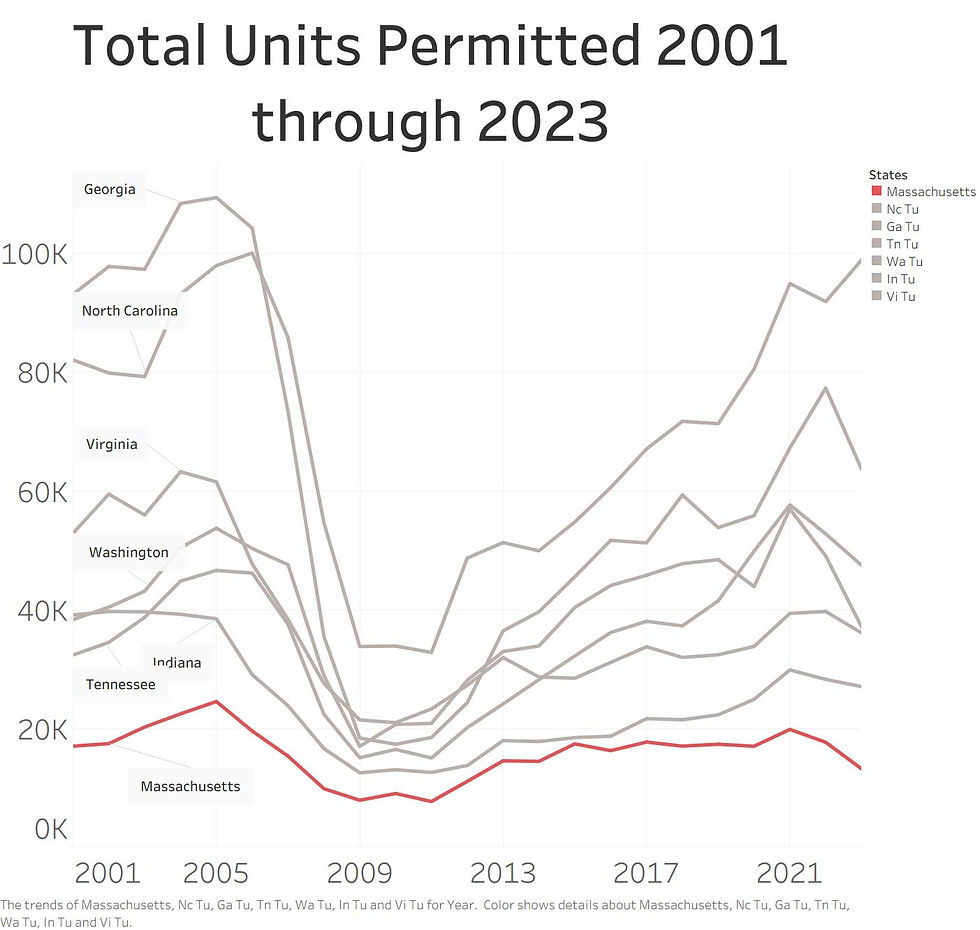
For Horn, people like the Marblehead man have a point. (She called the video of the zoning meeting likely “the best local politics story of the year” in an email afterward.) Horn believes the state is way behind in permitting and building new housing. In fact, in 2024, Horn put out a post on social media that looked at how much housing our state has permitted between 2001 and 2023 relative to similarly populated states and found Massachusetts was way down on the list.
Horn criticizes both wealthy suburban towns for shunning new multifamily housing as well as housing advocates in places like her own neighborhood of Dorchester who try to block new developments out of hand because they are too big or too tall.
“All these affordable housing advocates are like, ‘Don't build it so tall.’ And I'm like, ‘You want housing to be more affordable, and you’re fighting against the developers so that they build less housing?’ Do you understand supply and demand? These are problems that we've created because we've constrained supply so much.”
Horn has some ideas on ways to quickly help relieve the housing crisis, including supporting efforts to turn unused commercial and lab space into homes as well as ending the not-in-my-backyard attitudes that have prevented new construction around the state, especially around T stops.
Sampan spoke at length with Horn about her views on housing, prices, and more by phone. The following has been edited for clarity and brevity:
Sampan: First, so we’re on the same page, based on what you see ... do you agree that prices here are too high for many people?
Horn: Yes, for sure. I agree that there is a housing crisis in Massachusetts, but there are arguments about whether this is a U.S.-wide housing crisis or whether it is particular to large, coastal metro areas, not just here in Boston, but in places like New York, and San Francisco, which is worse.
Sampan: Well, that’s an interesting point, because if you look at housing in say Alabama or Mississippi, the cost is cheaper, but the incomes also tend to be lower. This leads to my next question, which is when I look at the Census data on income in Massachusetts, it feels like it’s a real haves-vs.-have-nots situation, where roughly half of the population does pretty well financially and rest is either just making it relative to housing costs or really struggling.
Horn: There are many components to affordability…. There’s the part that’s about whether housing is affordable. That’s a combination of the cost of housing and your income. So, if you have a very high income, you can afford a very expensive house. We define affordability if you pay 30% of your income on housing. You are cost-burdened if over 30% is spent on housing and you are severally cost-burdened if you pay more than 50% of your income on housing. If you break apart the question, then – and this is how I teach it in my class – you have an affordable housing problem in Boston and you have an affordable housing problem in Philadelphia. But you would say that the root causes for those affordable housing problems are very different.
In Philadelphia, they have lots of housing stock that we would consider affordable compared to our incomes in Massachusetts, but they have significantly lower incomes in Philadelphia. There's a much higher concentration of poverty, and a lot more people in the low income-spectrum. Whereas in Massachusetts or in Boston, you have (higher) incomes, but the housing is still unaffordable for many people…. So, there are a lot of dimensions to this problem. (Some places are more affordable for renters vs. homeowners and some homeowners have a mortgage and some no mortgage.) You can isolate the problem very clearly when we're talking about who is paying most of their income for their housing: It's low-income renters, it's renters on average….

Sampan: I wanted to zero in on that. If homeowners without a mortgage, and homeowners in general, tend to be the ones who are living within those thresholds of what’s affordable – paying that 30% portion or lower of their income on housing, then it seems like that alone almost creates even more inequality…. Aren’t those the same people who now have this asset that that's in general appreciating, whereas these renters do not?
Horn: Yes, once you've entered home ownership, you can lock in your housing costs, though obviously not energy costs and maintenance costs. With the 30-year fixed interest rate mortgage, you're also building equity. So, yes, that is a big part of the racial wealth gap, if you will. (And there are) definitely barriers to home ownership.
Sampan: People talk about the housing shortage problem in Massachusetts … but then, just anecdotally, we all hear of people who may have a house, let's say in some wealthy Boston-area suburb, and then they may have one on the beach, somewhere, like on the Cape. Or, they may have several rental properties that they own. Or they may have just a really huge house in a kind of a dense area. So, is it housing stock problem? Is there really not enough housing in Massachusetts? Or are there other pieces to the picture?
Horn: …Yes, I do think that there's not enough housing. We do not build enough. I made a post on Blue Sky (in November 2024) looking at how much are we building in Massachusetts relative to other states. I did this analysis where I look at all of the units permitted from 2001 to 2023. I said, “OK, how much are we building in Massachusetts relative to other states.” So, I took three smaller states and three bigger states by the 2000 Census population and I said, “How much did we build relative to them over that time period?” And we are at the bottom of all of them. … So that’s one way to look at this question. ...I really do think that it's decades-long refusal to build anything new.
(To the other part of your question), sure, there are very fabulously wealthy people in Massachusetts that have many homes and who can afford to build a new home, right, like and in an exclusive neighborhood and have lots of cars. But I'm not in the business of denying wealthy people wealth. But I am in the business of saying what pisses me off is when you drive through Wellesley and you see these people in their windows that have these signs that say, “Black Lives Matter,” and right below that sign, they have another sign that reads, “Say No to Multifamily Housing.” What do you mean by that? It's like, saying, “OK, black lives matter as long as there's no access for people with below-million-dollar incomes to my neighborhood.” What does that sign mean if you're advocating to stop building in your neighborhood?
Sampan: Not to blame students for the high cost of housing, but for a long time it’s been known that students can join together to rent, say a four or five room apartment or house, and each pay an amount that totals what would be high for a family to pay for that same place...
Horn: Ultimately, it's supply and demand issue, right? If there was more supply, this wouldn't be a problem. These are problems because we've limited supply so much….
It's like homelessness. This is such a good example. ...When you study homelessness and you look at the people who are homeless, they may have personal crises, they may have mental health issues, they may be veterans who don't have a family, right? All this is likely. But if you study the problems in housing markets that are very expensive versus in housing markets that are much more affordable, the problems are exacerbated in places where that cost of housing is just obscene, like in Massachusetts. …
Sampan: What about what some people say anecdotally about new construction that’s often marketed as market rate or luxury? They usually have really high costs for moving in, whether they're rentals or condos. Does that kind of construction contribute to the affordability problem?
Horn: There is good empirical evidence about filtering. The economic process that you're talking about is filtering.… The idea is that you build housing for the wealthy, and so the wealthy move into that housing and then they leave older housing stock for the middle class.… There's very compelling evidence, empirical evidence, that new construction -- this is the point that economists get really angry about – that new construction does not increase housing costs…
(But) supply skeptics say that when you put up new multifamily housing in a neighborhood that that's just making the neighborhood more expensive. Take Dot Block in Dorchester. It’s a great example. Rents were pretty low and then after this new project with a pool and clearly pretty gentrified population gets built – and even before so – you can see that all around it that these buildings are getting renovated and so there’s anger in the community that building this new building is making the neighborhood more unaffordable. That’s the argument. But the developers wanted to build Dot Block because there is demand for housing in that neighborhood. … So, the question is not that housing costs are going up around Dot Block but are they going up faster because Dot Block was built? Or does the fact that Dot Block is there actually slow down the rate that rents are going up in the neighborhood?
(According to studies, in general, there’s no) evidence that new construction raises rents in an area around the new buildings. They show a zero-effect or perhaps a negative effect. The reasoning is that what we see with our eyes, which is true, that when these new buildings come online, the rents are going up. But (that’s because) developers are building in neighborhoods where demand is growing. So, where they’re building these fancy new buildings is where they already sense that rich people want to go.
Sampan: It seems that there is a certain logic behind that… If you're a developer and you're going put down hundreds of millions of dollars to build an apartment or condo tower, you've already done market research that projects what this area's housing market will look like in five or 10, years from now, right? And so that they've already kind of been ahead of the curve of where these prices are going, right?
Horn: Exactly.


Comments