


‘My Home on the Moon’ Mixes 'Twilight Zone,' Pho and Queerness
“My Home on the Moon” is a whimsical and thought-provoking sci-fi comedy by playwright Minna Lee, presented by Chuang Stage at the Boston Center for the Arts. The play follows Mai, a Vietnamese American chef working in her family's struggling pho restaurant. When the business faces possible closure, a mysterious tech consultant named Vera arrives with seemingly magical solutions that transform it into an overnight success.
Sampan attended opening night on May 27 and spoke with members of the creative team about the play's inspiration, creative process, and central themes. The production runs through June 13 at the Plaza Theatre, Boston Center for the Arts. For tickets and more information, visit www.chuangstage.org/my-home-on-the-moon.
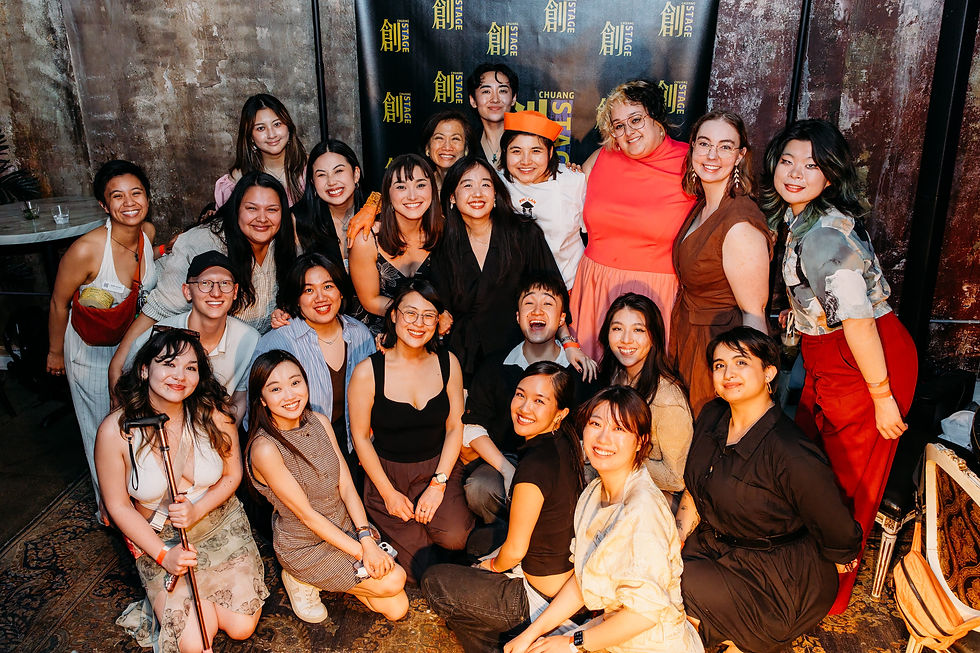
Sampan: The play weaves together so many themes—cuisine, love, technology, queer identity, survival, and more. What inspired you to bring all of these ideas into one work? And what kinds of conversations do you hope this play will spark within Asian American and queer communities?
Minna Lee (playwright): Most of my work is often a blend of different topics and worlds that I’m obsessed with. The “Twilight Zone” does that very well and watching that show taught me how to use the comfort of the known to create surprises and uneasiness when truths are revealed. At the same time, every episode still manages to highlight the warmth of life. I remember when I first started writing this play, I pretended that I was writing an episode of “The Twilight Zone” centered on Vietnamese food and queer characters. That prompt led to a lot of the unsettling things that happens within the story. I’m excited for queer Asian audiences to experience a play about love and culture set in a world of science fiction. Our identity deserves to be celebrated with range and magnitude — space ships, clones, mecha suits, give me all of it!
Sampan: What was the most challenging part of directing this production, especially with so many layered themes and storylines? And how did you come up with the creative ideas when setting up the stage and visual design?
Cara Hinh (director): The thing I love about directing is that what I am forced to do is look at the big picture. As we tweaked lines, shifted design ideas, I had to think about what kind of domino effect it would have on all of the pieces of the production. Another thing that I love is mess and chaos. It’s my favorite part of theater and maybe life, too! It’s the thing that makes art feel alive and real and connected. So when it came to all of the storylines, timeline, technology -- I love getting lost in the soup of it all with my collaborators and together building our bridge to the otherwise. For the design world, I shared with folks pictures of the Vietnamese restaurant I grew up in. Every Saturday my family would all eat together and the owners’ daughter became another sister to me. That place is what inspired Pho Lan and part of why I wanted to do this play – to honor my family.
Sampan: The characters Vera, Mai and everyone else have such strong on-stage chemistry, and it feels very intimate and authentic in the play. How did you build that connection and develop your characters and relationship?
Emma Na-yun Downs (Vera): It’s a blessing to be playing such a loving and selfless character like Vera, who truly sees Mai for who she is and fights for what’s best for her, no matter the cost. Mai and Vera wouldn’t be the same without Belle, and I am so grateful for their amazing artistry and friendship, and to Cara, Minna, our intimacy director Kristian Espiritu, and the entire team for making our rehearsal room so comfortable, open, and queer!
Belle Le (Mai): I think the safety of the rehearsal room really allowed us to explore both the gaiety (he he) and heavier moments between Vera and Mai. I couldn’t be more grateful for Emma and for the opportunity to find the most fun and interesting choices with her. We also couldn’t have found this without the leadership of Cara, Minna, and Kristian. Dream team!
Sampan: You both take on multiple characters, and it’s really fun to watch how you shift between them. What was your process like in creating these different roles, and what did you enjoy most about the experience?
Jenny S. Lee (Gigi, Camera Person, Chef 1, Lion Dancer): It’s a combination of saying “yes,” and to every brilliant comedic instinct Lee has and sinking into the wonderful world Minna has created for us through their words. I’ve loved getting to dig our teeth into this deeply resonant new work process with this amazing team, getting to play a villain (always a good time), and getting a free arm and leg workout via lion dance every night…
Lee (Beau, Food Critic, Chef 2, Lion Dancer): My process begins with written analysis and then using rehearsal time to explore and collaborate on what sticks. When playing multiple characters, I like to identify their similarities and differences from myself and from each other, focusing on emphasizing the differences while trusting the similarities will naturally come through. Because of Minna's fantastic writing, it was easy to distinguish the roles, from the heightened comedy of the Food Critic, to Beau’s earnestness and high stakes, and the Noodles' purely physical storytelling. What I enjoyed most was the variety, shifting between a movement based role, a sharp comedic character, and someone deeply sincere fighting for something important kept the work exciting and creatively fulfilling.
Sampan: Many people know you as a playwright, Christina, so seeing you step back into acting is exciting. How does it feel to be in front of the audience again? What do you hope your character communicates to the audience, and do you have any upcoming projects or plays you’re working on?
Christina R. Chan (Lan): It's a thrill and privilege to be playing a character so filled with life and joy at this stage in my theater career in an amazing play with talented actors. I hope my character communicates her "auntie" love.
Sampan: Finally, congratulations to Chuang Stage at Boston Center for the Arts on having its involvement extended for another three years. Is there any plan or message you would like to share with the Asian American community and beyond?
Alison: Me and the team at Chuang Stage are so, so grateful to be able to offer this historic arts block of the BCA as a hub for Asian American arts. Generations ago, our people lived out here. Early Chinese immigrants called the South End home long before these streets were lined with niche stores and expensive brunch places. And now, to be here making work, building community, gathering people, filling this space with our stories--means everything. Here, we want Boston Asians to see ourselves as a key part of Boston arts, always placed center stage. Our artists, our languages, our food, our humor, our grief, our joy--all met with the investment, care, and integrity they deserve. We will continue to do this for the next three years, and we can’t wait to see you here.


Comments