


Review: Asian American Ballet Project Taps Into World of Imagination, Storytelling
In many cultures, fairytales are used to help children better understand the world they live in. But these fantastical stories also hold value for adults, captivating their imaginations through symbolism and exploration of the human psyche.
These tales need not be restricted to spoken word, as demonstrated by the Asian American Ballet Project in its fourth annual performance, “Once Upon Our Time,” on June 27 and 28 at the Calderwood Pavilion at the Boston Center for the Arts. In this beautifully envisioned and spellbinding show, Asian folktales were powerfully presented through the art forms of ballet and other styles of dance. The show was rich, diverse, and eye opening, depicting traditional fables that are usually missing from mainstream, Euro-centric American narratives.
“Once Upon Our Time” opened with “Suho and the White Horse,” choreographed by Michael Lowe. In this work, a shepherd boy, Suho (Tristan Toy), befriends a beautiful white horse (Lauren Huynh) while playing in the plains of Mongolia. Huynh’s horse is spirited, free, and lively, and it’s easy to see why a greedy governor (Mollie Petrizzo) jealously seeks to claim the cherished beast for herself. Eventually, the horse is shot by the governor’s arrow, and the music turns mournful and dirge-like, as Suho clings to any last ounce of life the horse may have. She urges Suho to use her body to construct an instrument, the “Morin Khuur,” or horsehead fiddle, and the last scene of the piece is striking: A musician (Andrea Huynh) appears in the center of a circle of animal friends, bringing the horse’s soul to life through melody. The message, that in losing a wondrous gift, we must find other ways of holding on, was delivered poignantly and poetically.
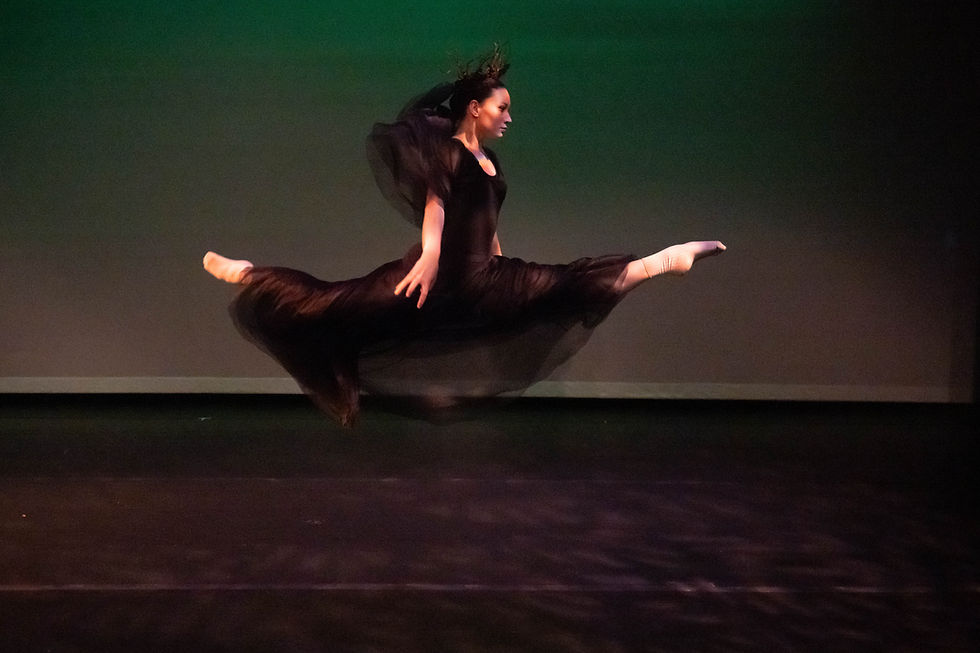
We then entered the world of a Philippine forest in “Gabi Sa Gubat” or “Night Jungle.” An array of creatures took the stage, using choreography planned by Alexa Capareda. This introduction to various mythological beings (Andrea Huynh, Lauren Huynh, Mollie Petrizzo, Rheya Shano, Amane Takaishi, and Tristan Toy) was perhaps the most haunting of all the works, as we meet a woman in a draping, black dress, twisting like shadows. At this gathering is the White Lady, the vengeful spirit of a woman wronged in life, duendes, or small goblin-like roamers of the night, aswang, which are shape shifters that blend into society by day and prey on humans at night, and more. There was no storyline per se; rather, audience members were experiencing a procession of otherworldly figures with unique and complex identities, all contributing to a sense of eeriness.
“Lon Po Po,” a Chinese folktale reminiscent of “Little Red Riding Hood,” choreographed by Adrienne Chan, was a highly theatrical work. Three young sisters flit about in satiny dresses, and while their mother (Mollie Petrizzo) prepares to leave them to visit their grandmother, she advises her responsible eldest daughter Shang (Amane Takaishi) to watch over the other two (Lauren Huynh and Andrea Huynh). A dramatic wolf (Kentaro Shiozawa) emerges, masquerading as the girls’ grandmother. When the trio realize they are in danger, they come up with a trick to thwart the wolf, climbing a gingko tree and promising to pull him to the top as well, only to drop him each time he tries to ascend. The storytelling makes strong use of exaggerated pantomime and is also conveyed through composer Julian Gau’s score, which is colorful, vivacious, and full of energy. Ultimately, the parable is one about using one’s wits to outmatch an adversary, while taking care of one’s family.
The show ended with the diaphanous “Tấm Cám,” a premiere from choreographer Lauren Huynh, with sweeping music from Christopher Vu. For those familiar with the fairytale “Cinderella,” this Vietnamese story has a similar plot. Tấm (Rheye Shano) is a kind-hearted, compassionate young woman who lives with her stepmother (Angelina Gibson) and stepsister Cám (Mollie Petrizzo). When she befriends a magical fish named Bống (Andrea Huynh), who dances across the stage in glittering attire, shimmering brilliantly, she is overjoyed. Though her envious family catches Bống and has her eaten, the spirit of the fish comes back to aid Tấm, bestowing her with a dress and slippers so that she may go to the Mid-Autumn Festival. The performance feels expansive, full of wonderful passages where wishes are granted through the glow of a basket and true love is found by the river, directed with Tấm and the King (Tristan Toy) she meets unknowingly walking backwards toward each other. As they serenely reunite, the conclusion is compelling.
While the Asian American Ballet Project shared four ballets with audiences, two guest performances were also part of the concert. “Eve – The Eternal Woman,” choreographed by Pandita Archana Joglekar and performed by Chinmayi Joshi portrays the biblical figure of Eve as someone who is repeatedly tested by life yet manages to choose tenderness and gentility over darkness. “Dance of the Storm,” choreographed by Peter Veth is a contemporary interpretation of the Khmer legend of Moni Mekhala and Ream Eyso, whose conflict with each other created thunder, lighting, and rain that we witness during storms.
“Once Upon Our Time” takes us on a journey through enchanting and spiritual realms that feel distinct from ordinary life but evocatively give expression to something else — what we experience in the subconscious. The shapes and shadows that we see, and the transformations that the characters undergo, may be the stuff of myths, but they portray what goes on in our inner selves. Through ballet, timeless stories are told as a revealing of our most hidden corners of the mind.


Comments