


The Philosophy of Artist Regina Linke
Creator of ‘The Oxherd Boy,’ ‘Big Enough,’ and ‘Little Helper’ chats about life, work, creating
The beauty of Gongbi style painting is that its precise detail and careful colorful shadings don’t take away from the breathtaking effect. The red roses are silky and bright. Aquamarine robes flow like ocean waves draped over a woman’s shoulders. Blue herons, peonies, and peacocks wander through gardens. A stunning opera singer looks at us, through it, and we’re not the same. Originating approximately 2,000 years ago during the Han dynasty, Gongbi had the advantage of blossoming during a time when political stability and economic prosperity allowed the arts to prosper. Perhaps it was the art of the privileged, the only group who could afford the beauty. Regardless, the stunning grace of Gongbi, the balance that it gives the viewer, is as close to perfection as a viewer could want it to be. Gongbi is a style that will remain throughout the ages.
In her 2024 book The Oxherd Boy: Parables of Love, Compassion, and Community, Taiwanese American artist Regina Linke (the pen name of Joy Lin) offers a foreword that paints a picture of the artist at a personal and career crossroads. She was in Taiwan, “...thirty-five years old, living in my parents’ home again on the other side of the world.”
The story of The Oxherd Boy originated out of a need to teach her child about the big things: life and death, love and fear, fairness, and forgiveness. Her teachings of the Three Harmonious Teachings (Taoism, Buddhism, and Confucianism) are manifested through an ox, rabbit, and the oxherd boy himself.
There is a lot of great wisdom in this book’s introduction, when she tells us that the slow work of creating this story, and its prequel Big Enough (about Ah-Fu before he became the oxherd boy) and the recently released Little Helper, helped her engage “...in the slow work of illuminating previously unexamined corners of her heart and mind.”
The Oxherd Boy is a gorgeous dialogue between an inquisitive young child who feels overwhelmed, and an ox who assures him that kindness shall overcome. Later, he assures the boy: “I see your suffering, and your pain is my pain.” Turn the pages and you’ll see a landscape of a cliff overseeing the ocean and these thoughts:
“Life’s greatest discoveries are
made by continually seeing
Home with fresh eyes”
It’s what the Ox believes that continuously engages the reader: “I don’t think you live free because you have a future. It’s rather because you don’t have a past.” It’s a struggle between the quest to gain knowledge at the risk of losing wonder, and The Oxherd Boy is fully aware of how that can happen. His new friend, the rabbit, argues that the quest for happiness is really just about the need to be healed. Later, Linke reminds us about life’s basic choices. Should we be accepted for what we are not, or should we be seen for who we truly are? The Ox ruminated about happiness, that it isn’t earned but rather cultivated together. The boy reflects on music, that he plays who he is but he’s always changing. Bright colors can come from dark places and beauty from broken spaces.
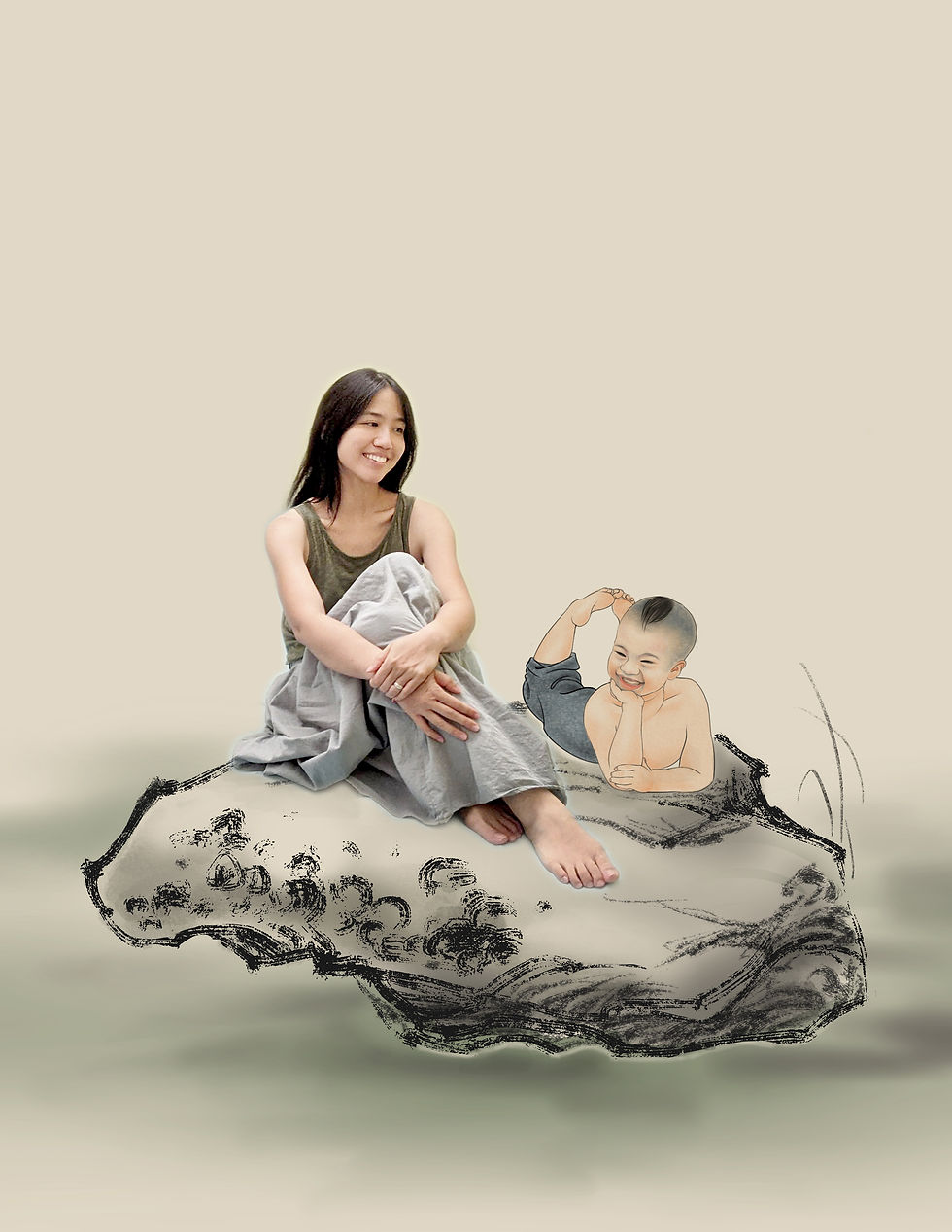
Once we finish this beautiful exploration of life, loss, gratitude, sadness, fear, purpose, and the future (among other things), Linke reflects on other philosophies that most influenced this book. The ancient Chinese philosophy paramount to understanding this journey of the boy, his grandfather, the ox and the rabbit is also enhanced by Sufi poetry, Hindu and Stoic philosophy. In Big Enough the paintings are more imaginative. Ah-Fu is younger, on a boat with ants helping steer the course. The fish are huge and the clouds dangerous. The plot hinges on whether or not he can retrieve the ox and bring him back home to his grandfather. Is the boy big enough? In Little Helper, we’re treated to another story whose basic message is contained in a simple fact: “A little help can make a big difference.”
Regina Linke was born and raised in Texas, She moved to Taiwan in her mid-thirties, at which point she began studying Chinese painting. She lives with her husband and son in Rhode Island. Sampan had the opportunity to interview Linke, via emailed questions, about (among other things) inspiration, dedication, form and tradition.
Sampan: The Oxherd Boy is really stunning, basically offering a sense of wonder on every page. How does it feel to see the entire story contained in such a beautiful bound volume? You’ve noted that you were more practical at 19 than you are now at age 40. How liberating is it to leave the world of marketing and international business and see this vision come to life?
Linke: Thank you. Starting the practice of writing and drawing pretty late in life, I'm always touched when I reflect on how lucky I was to work on this collection. It's not just the book itself, though all credit there must go to the passionate people at Clarkson Potter, who were dedicated to making it inviting and beautiful. But, I do see the book as a sort of time capsule that captures a state of mind and visual style during a pivotal moment in my life. Sometimes it feels bittersweet for me to reread The Oxherd Boy. It's like a memory that you yearn for even though it aches to relive it.
As a young adult, I was lucky to have many interests and the academic drive to excel nearly wherever I applied myself. That being said, when the only goal you have is to do well at something (and not worry your parents), you end up with a lot of energy, but lost as to where to apply it. I really didn't have the faintest idea about how to direct my ambition. I remember my mom asking if I'd be interested in pursuing the arts, but I brushed off the possibility, not only because I knew the likelihood of professional success was so small, but also because I was still absorbing from life and had nothing to express or say of the world yet. It didn't feel right to me at the moment.
So, I took a generalist path and studied business. It was the most universally applicable skill to develop for a young person still trying to figure out what she wanted to do but didn't want to starve in the process. I spent years learning about how businesses run in different settings — from a Fortune 500 company to the Peace Corps to a nonprofit. I saw a lot of the world and made friends with people from different walks of life, just absorbing and absorbing.
I never felt compelled to reflect on what I absorbed, to share or pass on what I felt to be true, until it was forced on me through parenthood. As the youngest in my family and never really involved with children or youth, I found myself suddenly having a small being look to me for answers to life's big questions, and it was a completely foreign experience. The answers weren't so clear cut anymore. It became harder for me to be always practical and rational when engaging with a child under five, whose perspective was tinged with both wonder and fear, a kind of awe that I hadn't personally felt in a long time. There were moments of sheer madness and extreme tenderness. And so, you could say to leave the practical confines with which I saw the world since in my teens was liberating. You could say The Oxherd Boy was my farewell letter to that state of mind.
Sampan: Could you give us a timeline of your artistic studies? How long were you not in the world of art? You’ve noted your formal studies didn’t start for a long time. The images here are really stunning and seem to be the result of a lifetime of hard work. Your assessment that you dabbled in painting every few years if inspired gives promise to a lot of us with such dreams.
Linke: I've always had some natural talent in the arts. As a child, I started drawing and painting on my own, and my parents enrolled me in some summer art classes, taking a few weeks to dabble in anything from ceramics to bas-relief to Chinese calligraphy. I also sang in my school choirs and joined orchestra as a violinist. Into my adult years, I wrote a play that was performed at my college, took a glass-blowing course, played piano, learned photography and photo editing, oil painting -- all as hobbies. But these pursuits were purely sporadic. Years could go by before I touched a keyboard, and then suddenly I'd spend hours hammering away at a new song I wanted to learn. Or much like scratching an itch, I'd churn out six or seven charcoal portraits in a few days and never look at them again. My work was good, but I could never bother to apply myself beyond whatever natural gifts I had.
It wasn't until I moved with my young family to Taipei when I was 35 or so, that I approached painting as a serious student, committed to practice and dedicated to learning proper techniques from a teacher. There were many art studios near where I was taking Mandarin classes, and I couldn't let the opportunity to learn traditional Chinese painting from a master pass me by. I found a small studio on Facebook and signed up to learn Gongbi-style painting. The class was small, probably six or seven students, and we would spend anywhere from six weeks to two months replicating a piece of art often a classic work from Gongbi canon — that my teacher Zheng Zhi-Hong picked based on our skill level. The class met for a few hours once a week, mostly spent listening to the teacher critique each student's assignment and watching him demonstrate the proper way to paint. I learned Gongbi techniques with him for about three years and spent another year learning a different style called Xieyi, which is a looser, more meditative and spontaneous type of brush painting that offers some balance against the more painstaking detail work required of Gongbi.
Somewhere in those four years, my love for the art deepened and I knew I wanted to continue practicing and creating in this style. But also at one point, my teacher let me know pretty definitively that I wouldn't make it as a traditional fine artist in this field. Not only was the competition too stiff, but it would be nearly impossible for me to reach the kind of philosophical and poetic depth required to make classical works of Chinese art. Having grown up in the U.S., my worldview is much too wired along the Western mindset, but what was a disadvantage in one area, became a portal into another. So, I believe it was in my last year of taking classes with him that I decided to shift to Gongbi-inspired illustration, and to begin trying painting digitally. At that point, my family had made plans to return to the U.S. and I wouldn't be guaranteed a supply of quality painting materials when I returned.
Translating traditional Chinese painting techniques and effects to the digital environment took me the better part of a year of trial and error to reach a level of execution that I could be satisfied with. Painting with traditional media offers a lot of sensory feedback: the smell of the ink or the sound of the stick spiraling against the ink stone, the tooth of the silk or paper against the brush. At first, working with a stylus on the iPad felt like I was painting blind. But I managed to get used to it, and it's been freeing to be able to take my work with me elsewhere beyond a physical studio. I paint pretty much anywhere, sometimes outside, on the couch with my dog, at our dining table where there might be laundry rack with the kids' swimwear drying right next to me. The flexibility allows me to create where my life happens to be, rather than isolated away in an ivory tower.
For many, my on-ramp does seem short to have produced the current body of work. I feel lucky that the opportunities and my dedication to this craft fell into place to make Oxherd Boy possible. I hope more people can do the same, too, especially later in life. I've seen many advantages as an older "soul" to learn a new craft. I hesitate to say "person," because physical age may have little to do with it. But an old "soul" often approaches being a student again with both humility and gratitude. He has the desire to apply oneself steadily, and hopefully the work experience to recognize and create opportunities to succeed professionally if that is where they want to take their craft.

Sampan: What do you mean by the “takeaway” in the creative process? Your work is indeed informed by feelings and concepts, as you’ve noted, so what role does the narrative play in it? Would you ever tackle a project that is more narrative/text driven or purely visual? You seem to be a master of both.
Linke: When I first began creating different The Oxherd Boy illustrations, many were motivated by the question or topic posed by my son. So it was important for the illustration and the words to respond to the question or barring that, leave the reader with some idea or feeling that he could walk away with to reflect on or sit with for a spell.
When it came to writing a longer narrative, a storybook for children, I had the chance to develop the question and answer, the conflict and resolution, the building of tension and release of feeling with a longer runway. In Big Enough, the story begins with Ah-Fu, the boy, accumulating the anxieties of everyone he passes on his way to bringing home the ox. The fear builds until the point of climax, and then the reader slowly sees in the second half, just how the fears resolve in a way that is not just unexpected and a little fun, but also noting that sometimes what we fear most doing is the solution to what we wish to achieve. In Little Helper, Ah-Fu is beginning to feel confident in everything, but the grown ups rightfully disagree. The first half is chaotic and the community disjointed, but Ah-Fu flows with the obstacles until he sees his chance to take the one effortless action that brings all the pieces together into a neat resolution.
To transition from a short work for children to a longer piece certainly expands on the narrative runway further. I've been playing with chapters of a longer piece that is only text. It's been interesting, because when working on children's books, I often start out with the words while thinking about what illustrations would support them. I make illustration notes when drafting out the story and only begin sketching after the first few drafts of the manuscript have been completed. Working on the longer piece is a bit of an arrested development of my previous process, where I do not make it to the sketching stage at all. Instead, I've taken my illustration notes and incorporated them into the text as descriptive paragraphs or supporting clauses sprinkled throughout dialogue. It's felt good to pivot in that way, to execute on my visualization notes in a different way.
Sampan: You’ve commented that the work is not yours any longer once it’s given to the world and that sense of non-attachment is very Buddhist. Are readers compelled to reach out to you and share their personal connections to your work? There are passages in The Oxherd Boy that are heartbreakingly beautiful, suitable for framing. How do you let go of such beauty once you’ve committed it to the page? You’ve reflected on both surrender and control as parts of the creative process. Is there ever a standoff between the two?
Linke: Yes, the Buddha taught that clinging to conditions, whether real or imagined, leads to a continual sense of unease or discomfort. And I found that that manifests itself in my creative process when I assign my identity to my work. If I consider the work to be a deeply personal expression of who I am, then once it's outside of me, it becomes a representative of my personhood, and any judgment on the work becomes a direct judgment on me and either adds or subtracts my sense of self-worth. But if I see the work as simply a snapshot in time, an imperfect tool through which some thought or some feeling is being channeled, then the stakes aren't so high. It's a form of communication between myself and whoever is reading or looking at it. I have to accept that the message transmitted may not be the message received, though I do strive for clarity and understanding.

I first started sharing The Oxherd Boy on Instagram, and when the account was still quite small, I think people felt more comfortable contacting me directly to talk about the characters and the topics they discussed. It was a very intimate time, to be able to connect directly with many people around the world who were touched by the messages in very personal ways and felt like they needed to talk to someone about it. I've discussed end-of-life concerns with octogenarians, young men and women going through heartbreak or searching for direction in life, and even a young widow who needed help finding the words to explain to her toddler where "Daddy" had gone. This is not to say that The Oxherd Boy has any or all of the answers. The best thing I have to say about the boy, the ox, and the rabbit is that they have their own perspectives to add to any single situation, and it's up to the reader to decide which is best.
It's been relatively easy to let go of what I think is beautiful, because I know there are those who cherish it. I'm sure it would have been a lot more difficult to keep this philosophy if the work hadn't met with such a warm welcome. But, as The Oxherd Boy went through the translation process, first from volunteers on Instagram and later with the full book, I've had to relinquish different sides of the story, whether visually or textually, to adapt the spirit of the message to a different perspective, language, or culture. This is where the standoff between surrender and control has occurred most frequently. Do I stay true to the core of what the teaching is, or am I open to adjusting the message to make it more palatable to a different kind of reader?
Sometimes it can feel like a betrayal or a cop out to change the message. But again, if I approach the work, not as a representative of something sacred and unalterable, but rather again, as a means of communication between two people, then I don't feel so conflicted. I can ask myself, "What is gained by saying something that will not be understood?" and "Can I change what I'm saying so I can be better understood?" Then, the possibilities open up, and creativity can flow once more.
Sampan: Would you ever want to illustrate somebody else's text? You’ve noted your attraction to the works of C.S. Lewis and Greek and Roman mythology. Would you adapt the text or give us traditional renderings? What part of you would be reflected in these illustrations?
Linke: Yes, I definitely would for the right project. It would be a lot of fun and an incredible challenge to work on something magical or mythological. Narnia was the first, most engaging series that I read as a child. I would revisit Edith Hamilton's Mythology time and again throughout high school and college. So, for works like theirs, and also like Susanna Clarke's Jonathan Strange and Mr. Norrell, I wouldn't touch the text, but it'd be wonderful to visually render some of the scenes and creatures to enhance the work. Maybe the part of me that appears in these projects would simply be in the act of giving Western works a Gongbi treatment. I think that'd be a very tidy ending to my painting teacher's prophecy. I may never become a fine artist in the classic Gongbi tradition, but I can find a new home for Gongbi elsewhere, and there's a certain beauty to finding a new resting place.
Sampan: Thanks for taking the time to answer our questions. The Oxherd Boy, Little Helper, and Big Enough are stunning and I can only hope these pages can come to life in other forms- animation, museum displays, or permanent murals. The story of this curious little boy and his thoughtful friends is a soothing balm in a world that’s getting darker every day.
Linke: That's high praise. And I hope everyone takes their chance to do the same and be a balm in some way for one another.


Comments